
How to Pair an LRN Probe with Your SmartBox
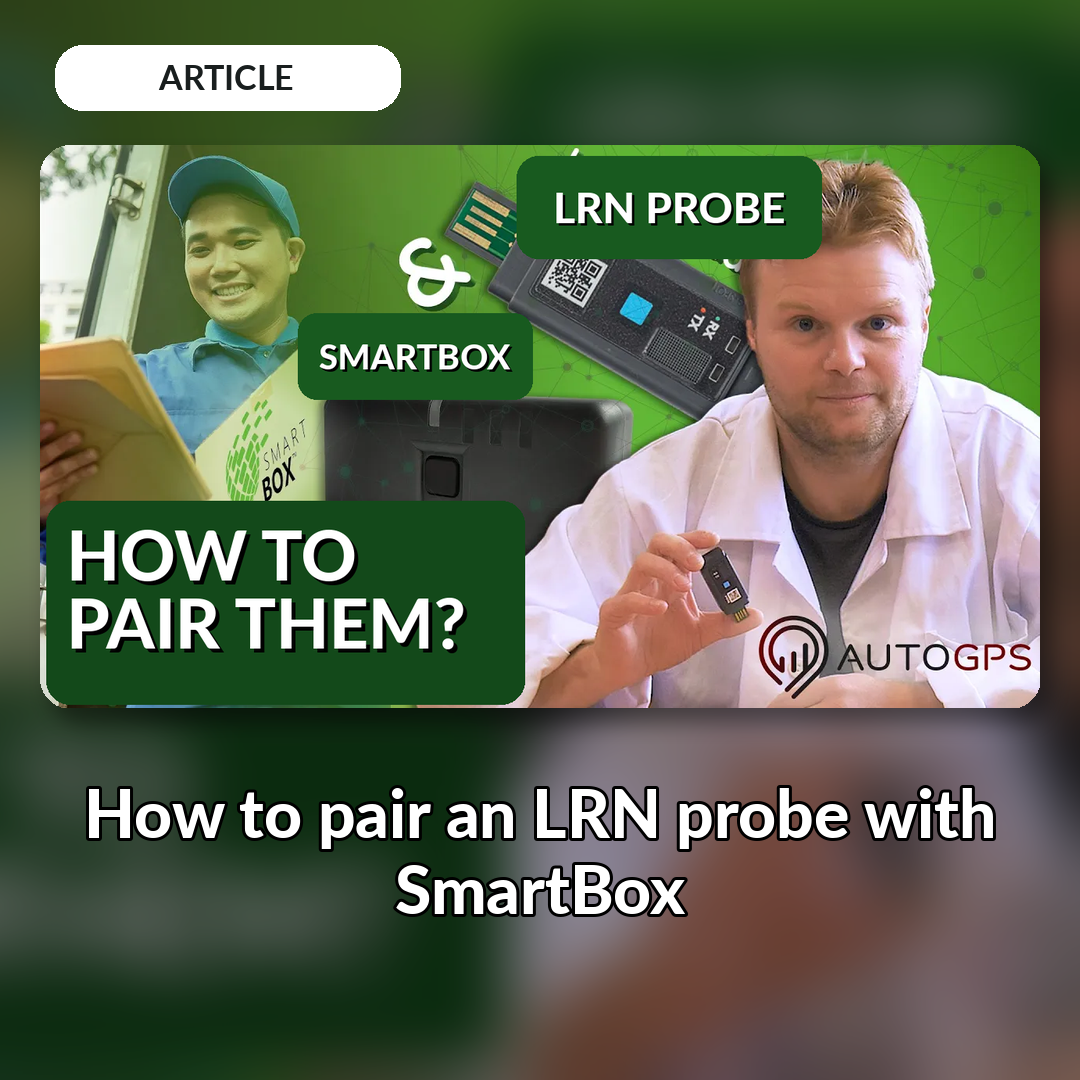
What an LRN probe and a SmartBox actually do
The LRN probe is a wireless sensor that connects to a SmartBox over LoRa at 2.4 GHz. It sits inside the load and reports temperature, humidity, air pressure, movement, impacts and tilt — a running record of the conditions your shipment is actually travelling in.
Its Wi-Fi scanner also estimates position in places a GPS signal never reaches: containers, warehouses, underground loading bays. A single SmartBox handles up to four probes at once.
The SmartBox is the central unit. It collects everything the probes measure, adds its own GNSS position, and pushes the whole picture into the MotoMon GPS platform.
The probe travels with the goods; the SmartBox stays on the outside of the load.
From there you get live location on Google Maps and OpenStreetMap, the complete history of the route and the conditions along it, threshold alerts for temperature, impact or unauthorised opening, and a documented trail that helps recover goods when a shipment goes missing.
Condition data is what turns a delivery dispute into a closed case. See how the full monitoring chain works in our guide to advanced transport monitoring.
Pairing the LRN probe with your SmartBox
1. Turning the probe on
Press the button briefly to check where the probe stands.
A solid red LED means the probe is switched off. Any other LED behaviour means it is already on, and the pattern tells you its current state — see the next step.
If the probe is off, hold the button down until the red LED goes out.
2. Reading the probe status
Three patterns, three states.
Red and green blinking together — the probe is not paired with any SmartBox.
Green blinking — the probe is searching for a tracker signal.
Solid green — the probe is connected and sending data. This is where you want to end up.
3. Pairing the two devices
Start on the SmartBox. Double-click the button, pause for a second, then double-click again — that opens the pairing window. The blue LED shows how many probes are already paired.
Now repeat the same sequence on the LRN probe. The green LED starts blinking rapidly as the probe looks for the tracker, then red and green begin blinking irregularly while pairing runs.
When the green LED goes solid, the pair is made. From that point on the probe reconnects to its SmartBox automatically every time you switch it on.
Four is the limit. If a SmartBox already has four probes paired to it, adding a fifth removes the oldest one from the list.
4. Checking the battery
Battery level is readable while the probe is unpaired. Click the button twice: the first click reports connection status, the second reports the battery.
Rapid red blinking means 95–100 %. The slower the blink, the less charge is left. A solid red LED means the probe is below 5 % and needs charging.
5. When pairing does not work
Three things to check, in this order.
Is the pairing window actually open? The double-click on the SmartBox is easy to mistime — repeat it and watch for the blue LED.
Repeat the pairing sequence on the probe. A single missed double-click is the most common cause.
Check the battery. Below 5 % the probe may power on but fail to hold a connection. If none of this helps, our support team can look at the device remotely.
6. Turning the probe off
Double-click the button — both LEDs light up. Then hold the button down until the red LED starts blinking, and release as soon as it does.
Once the probe is paired
That is the whole procedure: power on, read the LED, open the pairing window on both devices, confirm on solid green. The probe now reports environmental data alongside the SmartBox's own position for as long as the shipment is moving.
The setup is a one-time job. Every following trip, the probe finds its SmartBox on its own.

