
SmartBox Mini: asset tracking without installation


Most fleets know exactly where their trucks are. They know far less about everything the trucks are pulling, carrying, or leaving behind on site.
The assets that never get a tracker
Every operation has a second inventory. Trailers, tow-behind generators, light towers, welding rigs, pallet cages, rental compactors, roll-off containers, tool chests. They cost real money, they move constantly, and almost none of them have a tracking device on board.
The reason is rarely budget. It is that fitting a hardwired tracker means an installer, a power source, and a vehicle out of service for an afternoon. On an unpowered trailer there is nothing to wire into at all. So the asset stays invisible until the day it does not come back.
SmartBox Mini exists for exactly that gap. It is the smallest device in the SmartBox family, it carries its own power, and it attaches to a steel surface in about three seconds.
A tracker that needs an installer is a tracker that never gets fitted to the trailer, the generator, or the container that actually goes missing.
What the device actually does
SmartBox Mini is a self-contained LTE tracker measuring 3.3 × 2.0 × 1.2 inches and weighing 7.4 ounces. It fits in a closed hand, inside a toolbox lid, or behind a chassis rail.
Positioning runs on a u-blox M10S receiver reading four satellite constellations — GPS, GLONASS, Galileo and Beidou — with built-in jamming and spoofing detection. A hot start returns a fix in about a second; a cold start takes roughly 26 seconds.
The device reports position over cellular data to the tracking platform, where the movement history is plotted on maps and charts. Alerts go out by SMS, email or web notification when a rule is broken — a geofence crossed, a movement outside working hours, an SOS press.
Two environmental sensors are built in: ambient temperature from -4 °F to 140 °F and light level from 1 to 50,000 lux. A light reading is often the most useful signal on an enclosed asset, because it tells you the moment a container, cabinet or crate was opened.
Note on accuracy: the on-board sensors are uncalibrated and intended for indication rather than certified measurement. When a shipment needs defensible temperature evidence, connect the 1-Wire probe or use a SmartBox 2 model with an EMM probe.
The magnet mount
The magnet is what makes the device deployable by the person who already works with the asset, rather than by a technician.
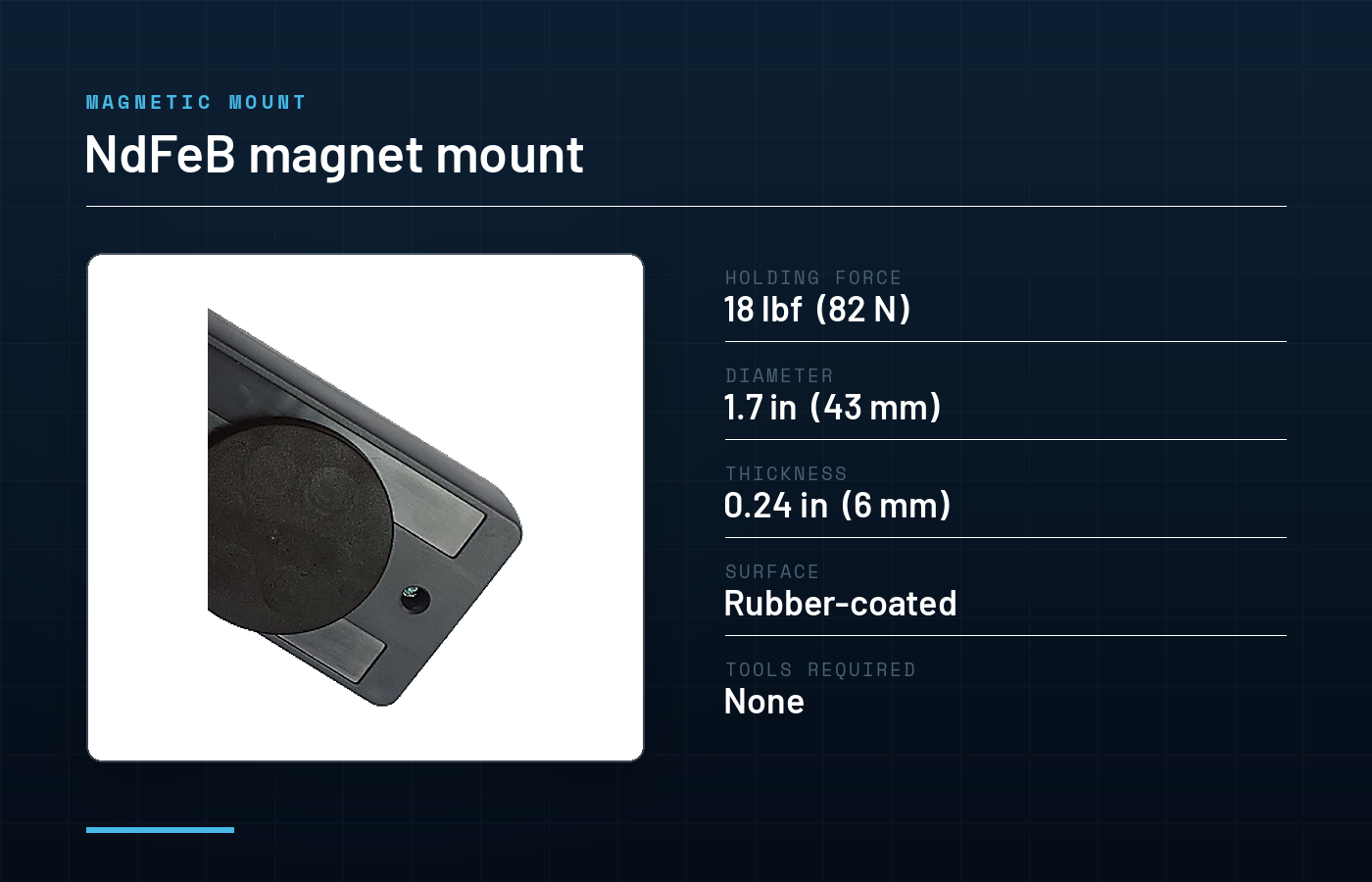
It is a neodymium disc of 1.7 inches diameter and 0.24 inches thick, with a holding force of 18 lbf (82 N). The rubber coating does two jobs: it protects paintwork from scoring and it stops the puck sliding under vibration.
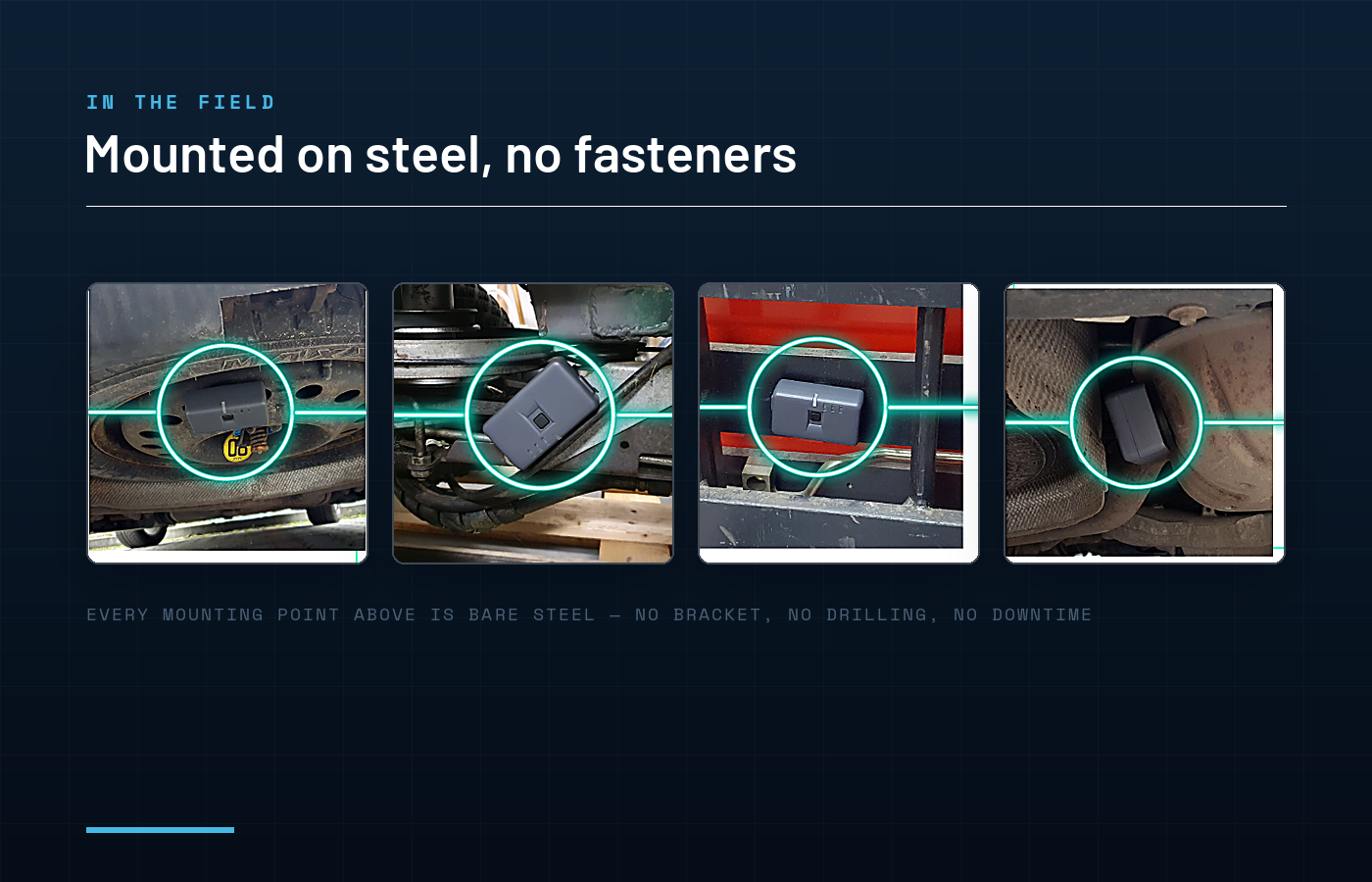
In practice that means any clean ferrous surface becomes a mounting point. A trailer drawbar, a container door frame, a generator skid, the underside of a steel toolbox. The asset does not need power, downtime, or a hole drilled in it.
Getting the placement right
Find clean, flat steel. Paint is fine, thick rust and heavy powder coating are not. Wipe the surface before mounting; grit under the rubber is the usual cause of a puck working loose.
Keep metal off the sky side. The GNSS antenna needs a view upward. Mounting the device on the underside of a heavy steel plate will cost you fix quality, so favour a vertical face or an edge over a deep recess.
Confirm the first fix before you walk away. Check the asset appears on the platform with a plausible position before the vehicle leaves. Thirty seconds of verification prevents a week of silent data.
Battery life decides the deployment
Everything about a batteryless-install tracker comes down to how long it runs between charges. SmartBox Mini uses a 2600 mAh cell and gives you a choice between reporting frequency and endurance.
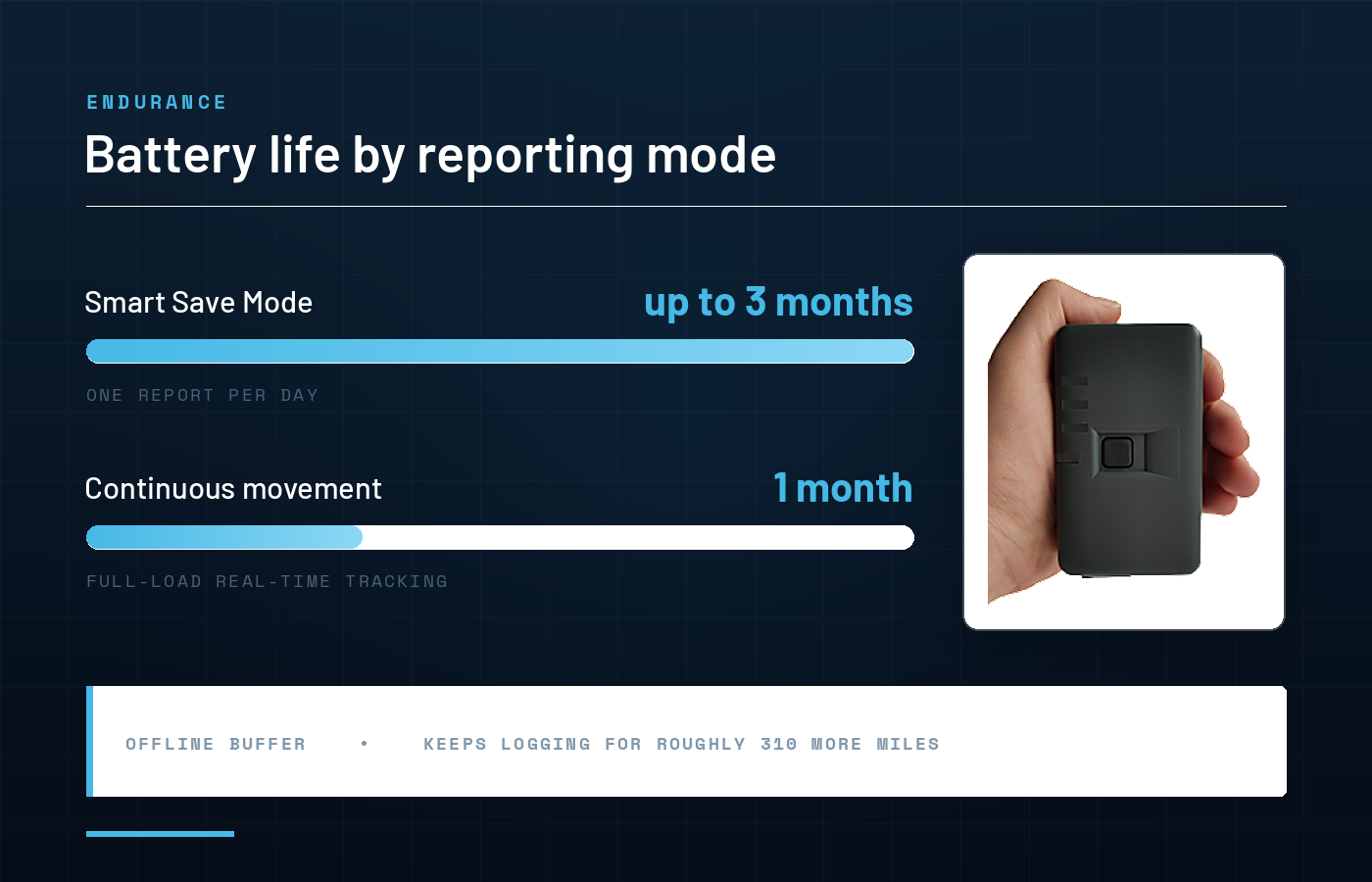
In Smart Save Mode, sending one report per day, the device runs for up to three months on a single charge. That profile suits static or slow-moving assets — stored trailers, seasonal equipment, containers waiting on a yard.
Under continuous movement and real-time reporting, expect around one month per charge. That is the profile for an asset in active rotation, and it still means eleven charging events a year rather than a permanent power feed.
Recharging is over USB-C, so a standard cable and any van charger will do. The device charges between 32 °F and 113 °F and operates from -4 °F to 131 °F.
When the battery does run down, the unit keeps logging position and probe data to internal memory rather than going dark. Stored records cover roughly 310 more miles of travel and sync once the device is charged again, which usually means the end of a journey is still documented even if the charge cycle was missed.
Where the Mini earns its place
Towed and unpowered equipment. Trailers, generators, light towers and compactors have no ignition feed to wire into, which is precisely why they are the most commonly stolen items on a site. A magnet-mounted tracker is often the only practical option, and it works the same way on remote sites with no infrastructure.
Rental and leased assets. Equipment out on hire tends to travel further than the contract says. Position history settles the question of where a machine actually spent the rental period, and it supports usage-based billing without an argument.
High-value single shipments. For a one-off consignment that does not justify a full monitoring build, a Mini can go inside the crate. Light-level data shows exactly when the packaging was opened, and the position trace shows where.
Field crews and lone workers. The configurable SOS button can be mapped to an alert chain of your choosing. For technicians working alone in remote locations, that converts an asset tracker into a check-in device without buying separate hardware.
Deploying it responsibly
Two limits are worth stating plainly, because both cause problems when they are discovered late.
The first is physical: the magnet needs ferrous metal. Aluminium bodywork, composite trailer panels, GRP enclosures and plastic tote boxes give you nothing to hold on to. On those assets, plan for a strap mount or an internal placement instead.
The second is legal. Placing a tracking device on a vehicle you do not own or control is regulated at state level in the US, and the rules differ significantly between jurisdictions. Deploy on company-owned or company-controlled assets, and confirm your own policy with counsel before extending tracking to anything else.
For shipments that need documented environmental conditions rather than location alone, the Mini is the entry point rather than the answer — that role belongs to a SmartBox 2 with probes and the TEMS evidence layer.

