
From Trunk to Backpack: Tracking Beyond the Vehicle
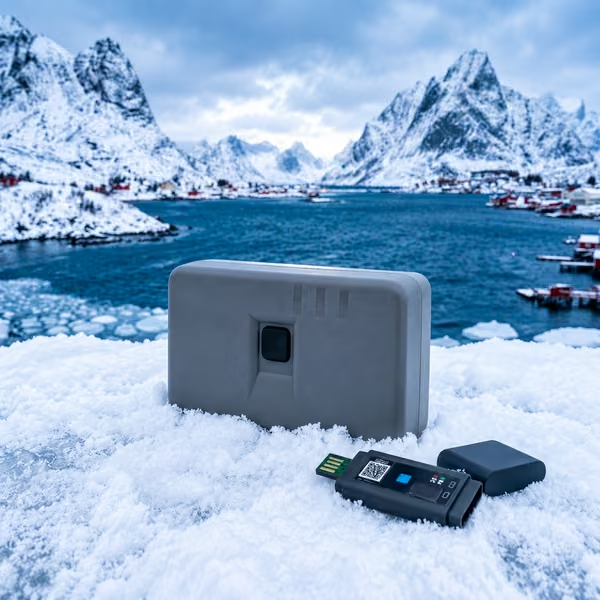
Most shipment tracking stops the moment a courier pulls the package out of the vehicle. That is exactly where we wanted to keep watching.
On a 10-day field test across Norway, Sweden and Finland, we placed a SmartBox Mini in the trunk as the main LTE unit reporting to MotoMon GPS. Inside a travel backpack, we packed two wireless LRN probes. The goal: find out what the data says about a "shipment" once it leaves the car.
How the setup works
The SmartBox Mini acts as the hub. It handles position, route history and cellular connectivity. The LRN probes are small wireless sensors that talk to the unit over LoRa, so they can sit inside a box, a bag or right next to the cargo — no cabling required.
We configured the two probes differently. One logged climate only. The second also had its accelerometer enabled to capture shocks and tilt. If you are setting this up yourself, see how to pair an LRN probe with your SmartBox.
Five things the probes told us
1. The data doesn't stop when the signal does
The first experiment took place in the port of Narvik. We parked the car and walked away with the backpack, well out of range.
Leaving the vehicle
As soon as the probes lose contact with the SmartBox, they switch to offline mode.
Out of range
Environmental and impact readings are stored in the probe's internal memory while it is out of range.
Back in range
When the backpack returns to the car, the probes reconnect automatically and upload the entire backlog to MotoMon GPS. The result is a complete record of the shipment, even where there is no cellular coverage.
Tracking no longer ends at the vehicle door. With SmartBox and LRN probes, a dot on the map becomes a complete record of the shipment.
2. Light levels show every time the bag was opened
For most of the trip, the backpack was closed and the probe reported near-total darkness — a light level of around 0.4%.
The data clearly shows every moment someone unzipped it: a sharp opening on the drive from Lofoten to Narvik, an evening search through the gear near Kautokeino, and a quick look inside at the North Cape cliffs.
In MotoMon GPS, you simply set a threshold — for example 1% light — and the platform sends an alert the moment someone opens the package. That is tamper detection and theft deterrence without any extra hardware.
3. Every impact has a timestamp
With the accelerometer on, you can see exactly when the cargo took a hit: two quick knocks while repacking in Tromsø, a series of impacts on a rough road near Kiruna, and overnight vibration while driving on icy roads in Lapland.
For damaged-goods claims, this is the difference between "someone probably dropped it" and a log that shows where and when the impact happened. It is documented proof of handling, not a guess.
4. Tilt in three dimensions
Beyond impacts, the probe also measures 3D orientation. On the overnight drive from North Cape back to Tromsø, the data shows the backpack's angle changing as the crew rearranged gear to make room for sleeping. First it sits askew, then it gradually settles, and finally it lies almost flat.
For boxes marked "This Side Up," you know exactly when that rule stopped being followed.
5. Two probes, two independent climate records
On the last night, both LRN probes ran in parallel, each with its own logging interval. Both measured temperature, humidity and air pressure.
The chart shows two independent "voices" that alternate and confirm each other: the conditions around the cargo stayed within limits. That kind of redundancy matters for vaccines, pharmaceuticals and lab samples, where a data gap or a single faulty sensor is not an option.
Where this setup makes sense
- Last-mile handoffs — see what happens after the package leaves the van.
- Pharmaceuticals and lab samples — redundant climate records along the whole chain.
- Fragile or high-value goods — impact and tilt logs for claims and accountability.
- Remote routes — offline logging where coverage drops out; learn more about tracking in remote locations.
The takeaway
Our route through Norway, Sweden and Finland showed that a SmartBox Mini with LRN probes extends shipment monitoring from the vehicle all the way into the backpack. Instead of a single position on a map, you get actionable insights into how the cargo was actually handled. For more ideas on deploying the Mini, see 5 real-world tracking scenarios.
Want to monitor your cargo beyond the vehicle?

