
Stationary or Portable Alcohol Detectors: Which One Fits Your Operation?

One impaired operator is enough to turn a routine shift into an incident, a claim, and an investigation. For fleets, plants, and field crews, that risk sits with the employer long after the shift ends.
Alcohol screening is how most operations close that gap — but the device you pick decides how much of it actually gets used. SYSDO supports two approaches: fixed detectors at a controlled entry point and portable detectors carried into the field. Both write into the same attendance record.
Fixed detectors: control at the entry point
A fixed detector is installed at a permanent checkpoint — a gate, a turnstile, a locker-room door. Everyone entering passes the same control, in the same order, every shift.
What it gives you
- Automatic identity match — the result is tied to a specific person, not to a slip of paper
- Access interlock — a positive reading can hold the door or turnstile closed, so the decision is made before someone reaches the equipment
- Shift-change throughput — built to screen large groups quickly when a whole crew arrives at once
- No paperwork — timestamp, identity, and reading are archived automatically
Where it fits
Production plants, distribution centers, and transport depots with a single controlled entrance. It works best where headcount is high, shifts are scheduled, and every arrival already passes through the same physical point.
A checkpoint only works if nobody can walk around it. Fixed detectors belong where the entrance is the bottleneck — and where you want the outcome decided before anyone touches a vehicle or a machine. Explore SYSDO
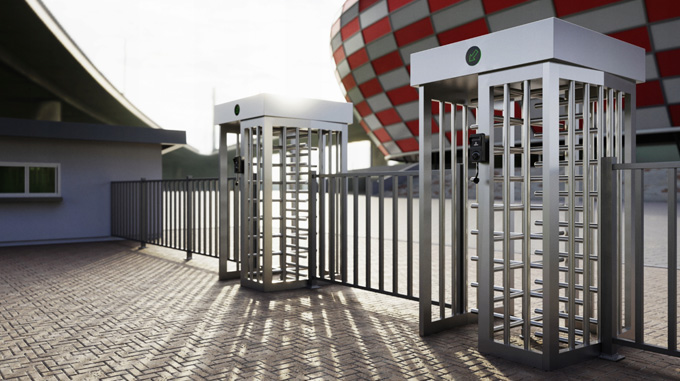
A fixed checkpoint screens an entire shift change without adding a supervisor to the process.
Portable detectors: testing where the work happens
A portable detector is a handheld unit a supervisor carries. It pairs with the mobile app, and results sync into SYSDO the same way a fixed reading does.
What it gives you
- Reach — job sites, yards, remote projects, and vehicles that never come back to a depot
- Selective screening — test one crew, one shift, or one individual without stopping everyone
- Immediate result — recorded against the person on the spot, with the same audit trail
- No installation — nothing to mount, wire, or commission
Where it fits
Construction and installation contractors whose crews start the day on site. Carriers and service fleets where drivers begin their shift at home or at a customer location. Smaller operations that don't have a controlled entrance to begin with.
This is also where alcohol screening lines up with the rest of your telematics. If you already track vehicles through fleet management or watch equipment on remote sites through heavy machinery monitoring, a portable detector closes the last gap: you know where the asset is, and now you know who is fit to operate it.

A handheld unit moves screening to the crew instead of moving the crew to the checkpoint.
Which one do you need?
High headcount, one entrance
Fixed detector. The checkpoint already exists; you're adding a step to it, not building a new process.
Crews and drivers who start off-site
Portable detector. A gate they never pass through can't screen them.
Both, in the same operation
Most mixed operations end up here. A fixed unit covers the depot, portable units travel with supervisors, and SYSDO holds both streams in one record — so a driver screened at a job site and a warehouse operator screened at the gate appear in the same report.
One record, whichever device produced it
The device is the easy part. What makes screening usable six months later is that every reading is attached to a verified identity and a timestamp, and that it lands in the same system as attendance and access.
That connection is what turns individual readings into something you can act on:
- Consolidated reporting — pull screening history by person, site, or period
- Access control that follows the result — configure what a positive reading does to entry rights
- Identity you can stand behind — the same verification logic described in driver identification applies here
- Scales with headcount — from a single site to an operation with thousands of employees
Before you switch anything on
Alcohol screening is a policy decision before it is a hardware decision. In the United States, breath alcohol testing of current employees is treated differently from drug testing, thresholds and procedures for DOT-regulated drivers are set federally, and several states place their own limits on random testing.
SYSDO gives you the screening, the identity match, the record, and the access interlock. What triggers a test, who gets tested, and what happens after a positive reading is your policy — written with your own counsel and, where applicable, aligned with the testing regime that governs your drivers.
Get the policy right first. The system will enforce whatever you decide, consistently, and keep the record.

